English
 中文
 Español
A line that ran within tolerance on Monday can produce out-of-specification product by Thursday without a single error code. Colour shifts slightly. Gauge variation widens. Scrap ticks up. The operator checks melt temperature, screw speed, and haul-off—all nominal. The variable that changed is invisible: the feeder has been delivering a slightly different mass per screw revolution than the recipe assumed, and the machine never knew it was guessing.
This is the quiet cost of conflating volume delivered with mass delivered. In plastic extrusion, the two are equivalent only when bulk density, particle shape, and flow behaviour remain perfectly stable. In practice, they rarely do. A gravimetric feeding system in plastic extrusion exists to close that gap—not by feeding “more accurately” in the abstract, but by measuring the variable that determines formulation: weight. If you are mapping feeding architectures before comparing specific configurations, continuous and batch gravimetric platforms provide a useful starting framework.
What “Gravimetric” Actually Means
A gravimetric feeding system meters material by weight rather than by volume. In extrusion, the dominant continuous architecture is the loss-in-weight (LIW) feeder: the hopper, material, and feeding mechanism sit on load cells, and the controller derives feed rate from the rate of mass loss over time. A volumetric feeder, by contrast, multiplies screw speed by an assumed bulk density—an assumption it never verifies.
The distinction is not academic. Bulk density is a measured property precisely because it moves. ISO 60:2023 specifies a method for determining the apparent density of plastics that can be poured from a specified funnel, acknowledging that packing, moisture, and particle shape cause the same material to occupy different volumes at different moments. A feeder that assumes density is constant is therefore assuming away the very variability that standards exist to quantify.
A second architectural distinction matters for extrusion decision-makers: continuous gravimetric feeding versus batch gravimetric blending. A continuous LIW system meters each component in real time as the extruder runs. A batch gravimetric blender weighs a complete recipe batch, mixes it, and discharges it to the extruder. Neither is universally superior; the appropriate choice depends on the recipe structure, changeover frequency, and traceability requirements of the line.
How Mass Measurement Corrects for Drift
The control loop is straightforward but demanding. Load cells continuously measure the combined mass of the hopper and its contents. The controller differentiates that signal over time to derive instantaneous mass flow, compares it to the recipe setpoint, and adjusts screw speed to close the gap. When the hopper reaches a refill threshold, the controller either holds the last valid gravimetric rate or switches to a bounded volumetric mode until weight measurement resumes.
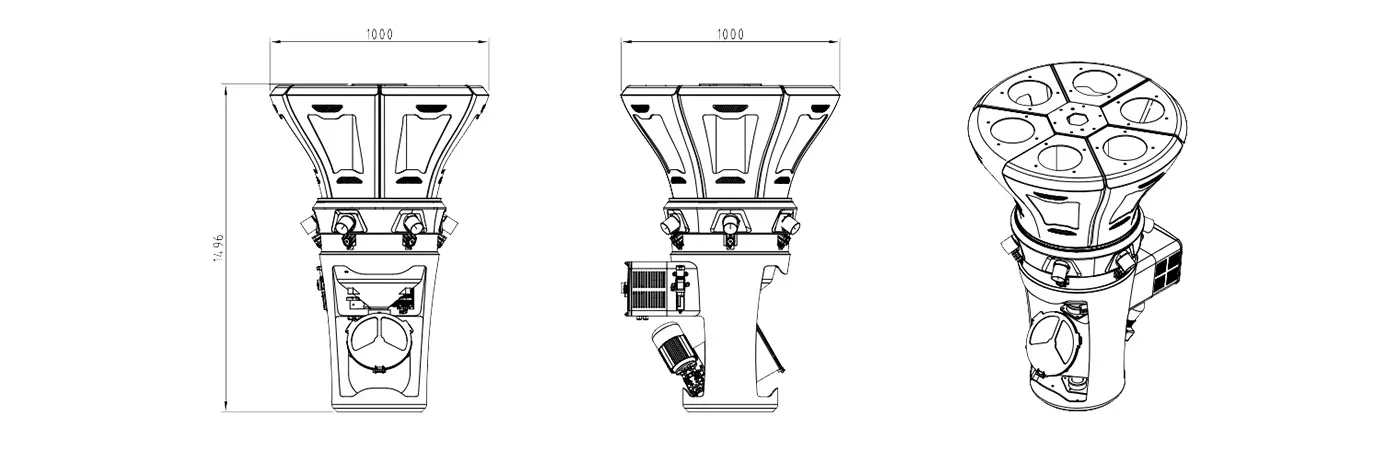
The practical value lies in what the system ignores. A shift in bulk density—whether from lot-to-lot variation, moisture absorption, or compaction—does not become a feed-rate error. The mass signal changes, the controller recalculates screw speed, and mass flow holds. A volumetric feeder would continue turning the same screw speed and deliver a different mass. In DEFINITI’s batch-oriented gravimetric blending architecture, the same mass-based principle is applied at the batch level: each component is weighed before mixing, and the system manages recipe execution, material control, and extrusion process data within an Industry 4.0 framework.
This is also why gravimetric systems generate a data trail volumetric systems cannot: every refill, correction, and deviation is recorded as a mass-based event. For processors running high-value additives or audited formulations, that record is the evidence that the recipe was executed as specified.

Key Factors That Determine Whether Gravimetric Control Delivers
Several variables separate a well-performing gravimetric system from one that technically measures weight but still drifts.
-
Bulk density stability of the material. Regrind, fluff, hygroscopic powders, and multi-source blends challenge volumetric assumptions most severely. If density changes between lots or across a shift, mass-based control is not a refinement—it is the baseline requirement.
-
Flow behaviour at the feed point. Fine powders may bridge or rat-hole; irregular pellets can surge. Screw geometry, agitation, and hopper design must match the material, or the mass signal becomes noisy regardless of load-cell quality.
-
Refill strategy. A gravimetric feeder is only gravimetric while it is weighing. Hopper sizing, refill frequency, and the controller’s ability to hold rate during refill determine short-term stability. Ask how the system behaves immediately after refill, not only in steady state.
-
Integration with extruder and haul-off. Feed-rate stability is necessary but not sufficient for product uniformity. The extruder’s speed stability and the downstream take-off response determine how well mass output translates into gauge.
-
Traceability requirements. If the quality system, customer audit, or regulatory pathway requires a mass-based production record, gravimetric control provides it by design. Volumetric systems can report screw speed; they cannot report mass delivered without an external check.
Volumetric, Continuous Gravimetric, and Batch Gravimetric Architectures
The following comparison reflects configurations represented in DEFINITI’s extrusion feeding portfolio, where loss-in-weight systems are stated at ±0.3% to ±0.5% accuracy and volumetric series at approximately ±1%. Batch gravimetric platforms are specified at 0.3% extrusion control accuracy and 0.5% mixing accuracy. These figures are configuration-dependent; they are useful for framing the decision, not for replacing application-specific validation.
| Decision factor | Volumetric feeding | Continuous gravimetric (LIW) | Batch gravimetric blending |
|---|---|---|---|
| Basis of control | Assumed bulk density × screw speed | Measured mass loss over time | Weighed batch, then mixed and discharged |
| Response to bulk density change | None; requires manual recalibration | Automatic correction via mass signal | Automatic correction at batch weigh-out |
| Reported accuracy (representative DEFINITI configurations) | ±1% | ±0.3% to ±0.5% | 0.3% extrusion control; 0.5% mixing |
| Best fit | Stable, single-source pellets; low cost of drift | Continuous multi-component extrusion; high drift sensitivity | Recipe management, batch traceability, frequent changeovers |
| Traceability output | Screw speed record | Continuous mass-flow and refill event log | Batch-level weigh and mix record |
The pattern is consistent: volumetric feeding is a bet that material behaviour will not change. Continuous and batch gravimetric approaches replace that bet with a measurement, differing mainly in where the measurement occurs and how the recipe is executed over time.
Four Questions Before Choosing an Architecture
Before comparing screw diameters or hopper volumes, a processor should answer four questions about the application itself.
-
What does formulation drift actually cost? A colourant at 1–2% letdown with broad visual tolerances may tolerate volumetric metering economically. A flame retardant, impact modifier, or barrier-layer component whose performance depends on precise loading almost always justifies mass-based control.
-
How stable is the material’s bulk density across lots and seasons? Free-flowing virgin pellets from a single qualified source are friendlier to volumetric assumptions. Regrind, filled compounds, and multi-source blends are not.
-
How is the recipe structured, and how often does it change? Continuous multi-component extrusion with a fixed recipe favours continuous LIW feeders on each component. Frequent formulation changes, batch-level traceability requirements, or a preference for centralised recipe management may favour a batch gravimetric blender such as the D-Batch architecture.
-
Does the process need a mass-based production record? If audits or internal quality systems require evidence of mass delivered, a gravimetric system provides that record natively. Volumetric systems require external verification.
A practical shorthand: if drift is costly and density moves, the decision is no longer volumetric versus gravimetric. It is continuous versus batch gravimetric—a choice governed by recipe logic and traceability, not by accuracy alone.
Where Gravimetric Stability Changes the Outcome
The effect of feed-rate stability propagates differently across extrusion processes.
In thickness-sensitive blown film lines, gauge uniformity is governed by the ratio of extruder mass output to take-off speed. A gravimetric feeder that holds mass output stable removes one variable from that ratio, allowing the thickness control loop—whether air-ring or haul-off—to respond to die and cooling conditions rather than chasing feeder drift. This is why loss-in-weight feeding is commonly paired with automatic air rings and online gauging in multilayer and high-output film lines.
In cast film and sheet co-extrusion, layer-ratio accuracy depends on each extruder’s mass throughput being independently controlled. Gravimetric feeders on each layer provide the measured mass signal that makes ratio control meaningful. Without it, the “ratio” is a screw-speed ratio, not a mass ratio.
In compounding and pelletizing, formulation fidelity across a wide additive range is the priority. Loss-in-weight feeders on each minor component allow the recipe to be executed by mass, even when individual components exhibit poor or changing flow behaviour. Batch gravimetric blending serves a related but distinct role: centralised recipe execution where each batch is weighed and verified before entering the extruder.
Refill, Calibration, and System Framing
Three operational realities deserve attention during evaluation.
Refill logic is part of the accuracy specification. A gravimetric feeder is only gravimetric while weighing. The controller’s behaviour during and after refill—whether it holds the last valid rate, switches to a bounded volumetric mode, or alarms—determines short-term stability. Ask for the refill transition behaviour, not only the steady-state accuracy.
Calibration remains material-specific. A calibration valid for one lot of concentrate may not hold for the next, especially after screw replacement or seasonal humidity shifts. Gravimetric systems reduce dependence on calibration accuracy, but they do not eliminate the need to verify that load cells and feeding mechanisms are functioning as intended.
The feeder is a formulation control system, not an accessory. Its value is not screw diameter or hopper volume in isolation. It is the stability of the mass signal it produces, the speed with which it detects deviation, and the clarity of the data it leaves behind. Evaluate it by what it measures and how reliably it measures it.
FAQ
Q: Can a gravimetric feeder compensate for a material whose bulk density changes during the run?
Yes. Because feed rate is derived from mass loss rather than assumed density, a density shift changes the screw speed required to hold setpoint, not the mass delivered. The controller observes the mass signal and adjusts.
Q: Is loss-in-weight feeding only for low-rate additive streams?
No. LIW feeders are used on main resin streams as well as minor components. The relevant question is not the rate but whether mass-based control is required. For a main stream whose stability governs product gauge, gravimetric control is equally relevant.
Q: What accuracy can realistically be expected from a gravimetric system?
Accuracy depends on configuration, material, and rate. Loss-in-weight systems in DEFINITI’s portfolio are stated at ±0.3% to ±0.5%, with batch gravimetric platforms at 0.3% extrusion control and 0.5% mixing accuracy. Treat any single number as a starting point for specification discussion, not a guarantee independent of material and installation.
Q: Does gravimetric feeding eliminate the need for downstream thickness control?
No. It stabilises the mass input to the die; it does not correct for die-lip variation, cooling non-uniformity, or haul-off fluctuation. Gravimetric feeding and downstream gauge control are complementary loops.
Q: What happens during refill, and why does it matter?
A well-designed controller holds the last valid gravimetric rate during refill, then resumes weight-based control once the refill settles. The evaluation question is how the transition is managed and how quickly valid gravimetric control is restored.
Q: When does batch gravimetric blending make more sense than continuous LIW feeding?
When the recipe is managed as discrete batches, when formulation changes are frequent, or when batch-level traceability is required. A batch gravimetric blender weighs each component and records the batch execution, which can simplify recipe verification and changeover procedures compared with continuous multi-feeder arrangements.
Related Products and Architecture Pathways
Once the decision framework points toward gravimetric control, the next step is matching the architecture to the line. The dosing and mixing platform groups continuous loss-in-weight feeders, multi-component systems, and batch blenders by control approach, making it possible to compare continuous versus batch architectures without starting from a single model number. For lines where batch recipe management and traceability are priorities, the batch gravimetric blending pathway describes how weigh-batch execution, material control, and extrusion process data are integrated in an Industry 4.0 framework.
Because feed-rate stability affects different extrusion processes differently, the application context matters as much as the feeder specification. Reviewing thickness-control logic in blown film or layer-ratio requirements in cast film before finalising a feeder configuration helps avoid specifying a technically capable feeder for a problem it was not designed to solve.
CTA: From Decision Factors to Configuration Comparison
Once you have clarified the application’s sensitivity to formulation drift, the material’s density stability, and whether the recipe is best executed continuously or in batches, comparing specific gravimetric configurations becomes the logical next step. The relevant distinctions are no longer “volumetric versus gravimetric” but rather which architecture—continuous loss-in-weight or batch gravimetric—fits the line’s throughput range, refill logic, changeover frequency, and traceability requirements. You can review the dosing and mixing platform to compare continuous and batch architectures, or examine the batch gravimetric pathway for recipe-management and batch-traceability considerations.
Related Reading
-
How Gravimetric Feeding Systems Improve Accuracy in Plastic Extrusion
-
Blown Film: A Buyer’s Guide to Applications, Supplier Evaluation, and Procurement Gaps
-
How to Improve Material Feeding Consistency in Plastic Extrusion
-
How to Choose an Air Ring for Different Blown Film Materials
This article is part of DEFINITI’s technical content library. No direct sales or pricing information is included. All technical discussions aim to help you make informed purchasing decisions