English
 中文
中文 Español
Article Overview: Compare blown film line sizing approaches for agricultural film and packaging. Evaluate air rings, extruders, and dosing systems with a process-first decision framework.
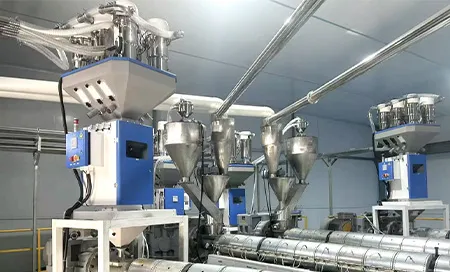
Selecting the right blown film line is a capital-intensive decision that affects throughput, film quality, and long-term operating costs. Technical decision-makers — CTOs, architects, and procurement teams — often face the question: should we start with the machine specification or with the process requirements? This article provides a structured comparison framework that puts process first, enabling buyers to evaluate blown film line components (air rings, extruders, dosing systems, and blowing units) objectively. We examine trade-offs between manual and automatic control, integration challenges, and scalability, with the goal of helping evaluation committees align equipment choices with production realities.
Process Considerations Before Machine Selection
Before specifying any machinery, the buyer must define the film's end-use properties: thickness range, layflat width, output rate, material type (LDPE, LLDPE, HDPE, or blends), and whether the line will produce agricultural film or packaging film. Process parameters such as melt temperature, cooling rate, and bubble stability dictate the required machine capabilities. For example, a line intended for heavy-gauge agricultural film demands higher melt throughput and robust bubble cooling, whereas a packaging film line may prioritize gauge uniformity and high-speed winding.
A common pitfall is selecting an extruder or air ring based on maximum output claims without verifying that the process can sustain those rates. The blown film line's performance is constrained by the weakest link — often the cooling capacity of the air ring or the consistency of the dosing system. Therefore, the first step is to document process parameters: target output (kg/h), blow-up ratio, frost line height, and desired mechanical properties. Only then can the machinery be sized to match.
For example, a hypothetical agricultural film producer requiring 500 kg/h output at 100 micron thickness would need an extruder with a screw design optimized for low-pressure melting and an air ring capable of delivering 10–15 m/s air velocity at the die lip. Starting with the process reduces the risk of over- or under-sizing.
Key Machinery Components: Air Rings, Extruders, and Blowing Units
Once process parameters are defined, the evaluation turns to three core components: the extruder, the air ring, and the blowing unit (also called the film blowing tower). Each component must be compared not in isolation, but as part of an integrated system.
Extruder Comparison Criteria
Extruders vary by screw diameter, L/D ratio, barrel cooling, and drive power. For blown film, low-pressure film blowing units often use extruders with barrier screws to improve melting homogeneity. Buyers should compare specific throughput (kg/h per rpm) and torque output. A key trade-off: higher output screws may increase melt temperature, affecting bubble stability. The buyer must match the screw profile to the polymer's rheology. For instance, HDPE requires higher shear, while LDPE benefits from gentler mixing.
Air Ring Technologies
The air ring controls the cooling rate and bubble diameter. Traditional manual air rings rely on operator adjustments for air volume and velocity, which can lead to gauge variations. Automatic air rings, such as those offered by some manufacturers, integrate stepper motors and air valves for closed-loop control, enabling consistent film thickness. Some suppliers also offer dedicated solutions for high-density films with calibrated air flow channels. The choice depends on the required tolerance: for commodity films, manual rings may suffice; for high-spec agricultural or packaging films, automatic control is recommended. For an overview of complete blown film system options, buyers can consult industry references.
Blowing Unit Layout
The blowing unit includes the die, nipping rollers, and winding station. Evaluation criteria include die gap adjustability, roller alignment, and tension control. Low-pressure units are common for thin films, while high-pressure designs support thicker gauges. Buyers should compare maximum layflat width and winder speed against their target output.
Comparison of Air Ring Technologies: Manual vs. Automatic
This section provides a direct comparison between manual and automatic air ring systems, using typical specifications as reference points.
| Criterion | Manual Air Ring | Automatic Air Ring |
|---|---|---|
| Air volume control | Manual valve adjustment | Stepper motor with air valves |
| Thickness consistency | ±5–10% depending on operator skill | ±1–2% with closed-loop feedback |
| Output stability | Dependent on operator intervention | Automated compensation for die swell and melt variations |
| Setup complexity | Low initial cost; higher labor cost | Higher initial investment; lower running cost |
| Suitable film types | Commodity films, low-tolerance applications | High-value films, agricultural, barrier, multi-layer |
| Retrofit feasibility | N/A | Can be retrofitted on existing lines (example scenario) |
The trade-off is clear: manual air rings offer lower capital expenditure but require skilled operators and allow more gauge variation. Automatic air rings provide consistent quality and reduced scrap, but demand a higher upfront budget. For buyers evaluating a complete integrated solution, the air ring should be selected based on the process tolerance requirements. If the line will produce film for critical applications (e.g., greenhouse covers with strict light transmission), automatic control is strongly recommended.
Integrating Dosing and Mixing Systems for Consistency
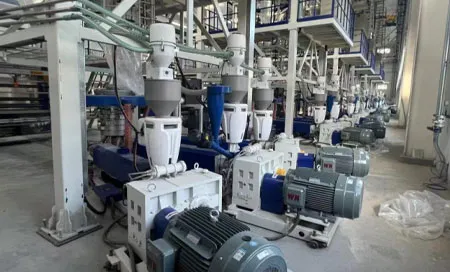
Film quality depends not only on the line's cooling and extrusion but also on the consistency of material input. Dosing and mixing systems ensure that additives, colorants, and regrind are blended accurately into the virgin polymer. The available dosing mixing product range includes batch blenders, loss-in-weight feeders, and screw feeders that can be integrated directly with the blown film line.
Comparison criteria for dosing systems include accuracy, throughput, and material handling flexibility.
- Batch blenders offer ±0.1% mixing accuracy and are ideal for recipes with multiple components. They batch materials in cycles, which may cause slight interruptions in continuous lines unless buffer hoppers are used.
- Loss-in-weight feeders maintain ±0.25% accuracy continuously and are preferred for steady-state extrusion. They occupy more vertical space.
- Screw feeders are volumetric and less expensive, but accuracy can drift if material bulk density changes. They suit low-cost commodity lines.
The decision point: if the film line runs a single material at constant output, a loss-in-weight feeder may be overkill. For multi-layer films or frequent recipe changes, a batch blender with precise weighing minimizes waste. Buyers should also consider the integration of Industry 4.0 control systems for real-time recipe management.
Evaluating Total Line Performance and Scalability
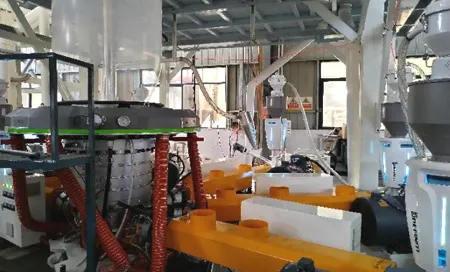
After comparing individual components, the buyer must assess how the line performs as a whole. Key metrics include overall equipment effectiveness (OEE), changeover time, and the ability to scale output. A process-first approach means that the line's bottleneck is identified early. For example, if the air ring cannot cool the bubble fast enough, increasing extruder speed will only cause melt fracture or bubble instability.
Scalability considerations: Can the same extruder be fitted with a larger die or a different air ring for future product lines? Are dosing systems modular? Some suppliers offer standardized frames that allow adding feeders later. The buyer should request reference installations and ask about retrofit paths. Also, consider the supplier's service network: a line from a single-source vendor may simplify integration, while best-of-breed components may offer superior performance but require more engineering effort.
Another decision checkpoint is the control architecture. A unified control system that links extruder, air ring, and dosing can improve synchronization. However, proprietary protocols may lock the buyer into a single vendor. Open standards (like OPC UA) are preferred for multi-vendor lines.
Frequently Asked Questions
What is the first step in sizing a blown film line?
Which is more critical for film quality: the extruder or the air ring?
When should I choose an automatic air ring over a manual one?
Can I retrofit an automatic air ring onto an existing line?
How do dosing and mixing systems affect blown film line performance?
Conclusion
Sizing a blown film line requires a disciplined, process-first methodology. By defining the film's end-use requirements and then evaluating extruders, air rings, blowing units, and dosing systems against those parameters, buyers can make objective comparisons. The trade-offs between manual and automatic air rings, between volumetric and gravimetric dosing, and between single-vendor and best-of-breed solutions are all resolvable when process constraints are clear. Use the comparison tables and criteria in this guide as a starting point for your evaluation, and always test candidate configurations against your specific product profile. Ultimately, the line that best aligns with your process—not the one with the highest spec sheet—will deliver the best return.